Building an agricultural sprayer drone
Payload, pump control, simulation, and staged testing of an octocopter prototype.
From Hassan Kamran’s personal archive. Revised on 16 November 2026.
This project started with a practical engineering question: could an agricultural spraying system be built around an octocopter at a lower prototype cost? My original write-up described the hardware, simulation, and staged testing. Those details are more useful than the headline savings.
Build around the payload
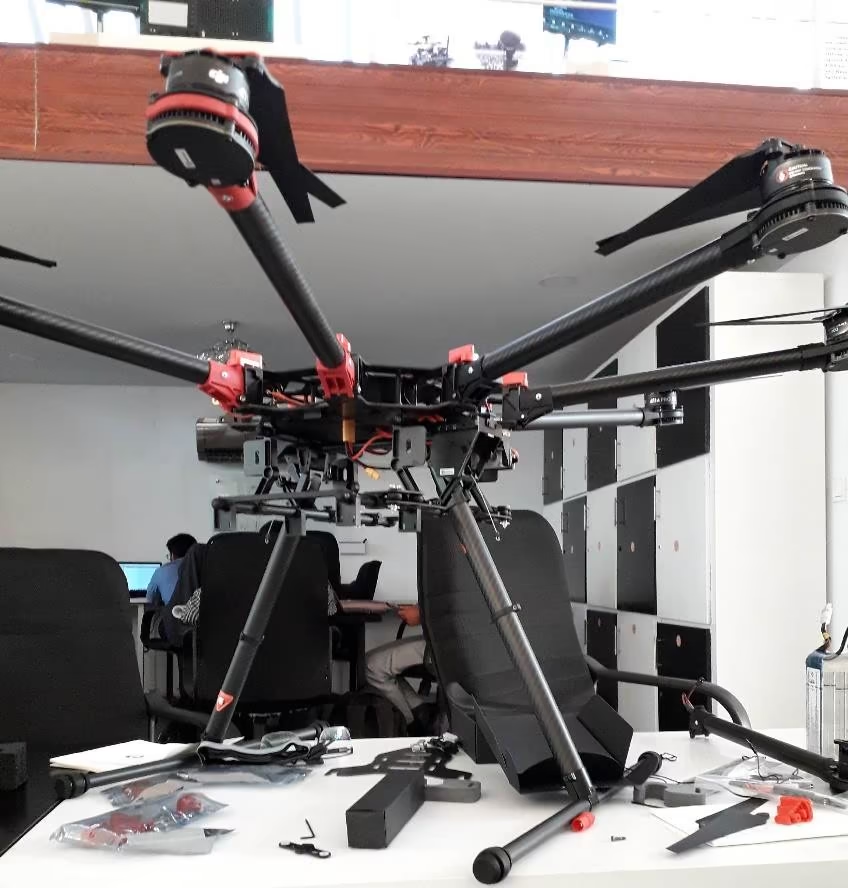
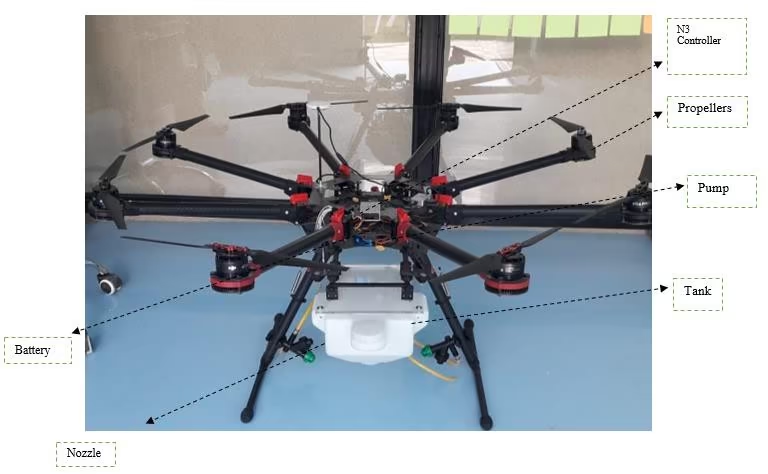
The aircraft used an eight-motor carbon-fibre frame, a DJI N3 flight controller, and two 6-cell 8,000 mAh batteries connected in parallel. The spraying assembly added a five-litre tank, a 12V pump, and flat-fan nozzles.
The tank was not just another component to bolt on. Its mass and position affected the aircraft’s centre of gravity, while fluid consumption changed the payload during operation. The mounting arrangement and component placement therefore mattered alongside the flight controller.
Keep the spraying mechanism simple
An Arduino Nano and an L298N driver controlled the pump. The assembly used an acrylic mounting plate to limit additional weight. Nozzles were mounted on the retractable landing gear so their orientation changed when the gear retracted.
That arrangement tied a spraying requirement to hardware the aircraft already had. It also made nozzle placement, clearance, and the behaviour of the landing gear part of the test plan.
Simulation and hardware testing were different steps
I used ROS, Gazebo, and PX4 for the simulation work. The physical prototype used the DJI controller. Simulation helped explore the system, but did not replace checking the assembled aircraft.
Hardware testing proceeded in stages:
- Check basic flight behaviour without the spraying assembly.
- Fit the assembly with an empty tank and reassess the aircraft.
- Add fluid and examine flight and spray behaviour together.
This sequence made it easier to separate an airframe or control problem from a payload or spray-system problem.
Keep calculated comparisons separate from measured results
The original project included a mathematical comparison for one acre: 16.05 minutes for manual spraying versus 7.49 minutes for the drone, with estimated water use of 59.4 and 9.6 litres respectively.
Those figures are estimates under the comparison’s assumptions. They are not evidence of equivalent crop treatment, repeatable performance across different farms, or the elimination of operator exposure. Refill time, battery changes, conditions, and application quality all matter when evaluating a working system.
The prototype’s reported cost was approximately US$3,000–3,500 at the time. Comparing that directly with larger commercial systems also needs care: tank size, endurance, support, and capability were different.
What remained to be developed
GPS-waypoint navigation, longer endurance, and greater payload capacity were future directions in my original account. They should not be presented as capabilities demonstrated by this prototype.
The project brought together the parts of mechatronics I enjoy: simulation, mechanical packaging, electronics, and testing a physical system. The research is listed in IEEE Xplore as “Low Cost Agricultural Sprayer Drone Development”. There is also a video of the drone demonstration.